Area Real Estate News & Market Trends

You’ll find our blog to be a wealth of information, covering everything from local market statistics and home values to community happenings. That’s because we care about the community and want to help you find your place in it. Please reach out if you have any questions at all. We’d love to talk with you!

Oct. 25, 2026

What Is a Mother-in-Law Suite, and How Is It Different from a Basic Guest Room?

TodaysEastTexas

Your Complete East Texas Real Estate Guide

www.TodaysEastTexas.com

What Is a Mother-in-Law Suite, and How Is It Different from a Basic Guest Room?

BM

Bob McCranie

Broker Associate, Texas Pride Realty Group - HomeSmart Stars

★★★★★ 45 Google Reviews | 24-Year Veteran Real Estate Agent | Over 1,150 Homes Sold | REALTOR® Since 2003

Quick Answer
A mother-in-law suite is a self-contained living space with its own bedroom, full bathroom, and at least a basic kitchenette, designed for independent living. A guest room shares the home's kitchen and bathrooms and is meant for visiting. The difference affects value, permits, and how the space can be used.

What a Mother-in-Law Suite Actually Is

Q: What is a mother-in-law suite?

A mother-in-law suite, sometimes called an in-law suite, granny flat, or private suite, is a self-contained living area inside or attached to a home. Unlike a standard guest room that depends on the rest of the house for cooking and bathing, a true suite is built so someone can live there independently for extended periods. Bob McCranie, a 24-year veteran real estate agent with over 1,150 homes sold, puts it simply: a guest room is for visiting, and a suite is for living.

In East Texas, these suites appear in several forms. Some sit on the main floor with a private entrance, a bedroom, a full bath, and a small kitchen. Others are converted garages, finished basements, or detached cottages in the backyard. Layouts vary widely across Tyler and Longview, so knowing the core components helps you compare fairly.

The Core Components That Define a Suite

Q: What features turn an extra bedroom into a true suite?

Most agents and appraisers look for four things: a private bedroom, a full bathroom not shared with the main house, a kitchen or kitchenette with a sink, a refrigerator, and a cooking appliance, and a separate sitting area. A private entrance is a valuable bonus because it adds privacy and resale appeal, but it is not always required. Listings in Nacogdoches and White House range from full suites to simple bedroom-and-bath add-ons. Bob McCranie tells buyers to walk through the space and ask whether someone could cook, sleep, bathe, and receive visitors without entering the main living area. If the answer is no, you have a bonus room rather than a suite.

Suite Versus Guest Room: The Practical Differences

Q: Why does the difference matter when you are buying or selling?

The distinction affects how a property appraises, how it is insured, and how local officials view the space. A guest room is generally considered part of the single-family home and does not change how the property is used. A fully independent suite with a kitchen can raise questions about whether the property functions as two dwelling units, and some cities regulate that closely. Before you assume the space counts as finished living area, confirm the square footage and permit history. Bob notes that buyers who skip this step often discover a mismatch only after the appraisal arrives.

Privacy, Access, and Daily Comfort

Q: How much privacy does a suite really provide?

Privacy is the main reason people choose a suite over a guest room. Well-designed suites have solid interior doors, good insulation between walls, and a separate path to the outdoors. A separate thermostat or ductless mini-split matters during East Texas summers. A home with a suite in Athens or Marshall may cost somewhat more than a comparable three-bedroom home, but the added flexibility often justifies the difference.

Common Uses for a Suite

Q: Who typically uses a mother-in-law suite?

Some owners use them for a relative who needs regular support, others for a long-term houseguest, a live-in caregiver, a home office, or a rental income source. Because needs change over time, the most useful suites are flexible. A layout that works for a caregiver today may later serve as a rental or a guest retreat. Bob McCranie often explains to buyers that a suite gives a home more than one purpose, which is especially helpful if you plan to sell later.

"I had a client who bought a home in Lufkin mainly for its suite," Bob recalls. "Her mother moved in about six months later, and the separate bathroom made the arrangement work without anyone feeling crowded."

Questions to Ask Before You Commit

Q: What should you verify during due diligence?

Start with the permit history. Ask whether the suite was built with permits and passed a final inspection. Check the city or county website for rules on accessory dwellings. Review the local regulations on zoning and rental use in your target city, because rules can differ significantly from one municipality to the next. Confirm the utility setup as well. Some suites share a single water and electric meter with the main house, which affects monthly costs and who pays them. Finally, have an inspector check the plumbing, electrical wiring, and kitchen appliances in the suite, since those areas are often overlooked. Our buyer resources outline the full process.

Design Considerations for the Long Term

Q: How do you make a suite useful for many years?

Think beyond today's needs. Wider doorways, level thresholds, grab bars in the bathroom, and a bedroom on the ground floor all make a suite easier to live in as circumstances change. For more ideas on homes that support long-term living, read this guide on finding the best homes for aging in place. Bob advises clients to choose a suite that could stand alone as a comfortable apartment, because that flexibility protects the investment whether the space is occupied by a relative, a guest, or a tenant.

How a Suite Affects Resale

Q: Will a mother-in-law suite help or hurt when you sell?

Resale depends on execution. A well-finished suite with its own bathroom, clean finishes, and permitted construction tends to attract buyers. A poorly built conversion with unpermitted plumbing can discourage lenders and inspectors. Keep permits and receipts in one folder. When you are ready to list, our seller resources explain how to present the suite effectively. Bob reminds sellers that accurate measurements and permit details in the listing build buyer confidence.

Making Your Decision

A mother-in-law suite is more than an extra bedroom. It is a self-contained living space that can serve a relative, a guest, a caregiver, or a tenant. Knowing the difference helps you evaluate listings accurately and avoid surprises at appraisal. You can learn more on the agent profile page or explore the East Texas market blog for additional homebuying guidance.


Contact Bob McCranie at Texas Pride Realty Group - HomeSmart Stars | 972-754-0582 | www.TodaysEastTexas.com for a FREE 2026 Market Strategy Session
Sept. 30, 2026

Jacksonville vs. Rusk: Which East Texas Town Should Home Buyers Consider in 2026?

TodaysEastTexas

Your Complete East Texas Real Estate Guide

www.TodaysEastTexas.com

Jacksonville vs. Rusk: Which East Texas Town Should Home Buyers Consider in 2026?

BM

Bob McCranie

Broker Associate, Texas Pride Realty Group - HomeSmart Stars

★★★★★ 45 Google Reviews | 24-Year Veteran Real Estate Agent | Over 1,150 Homes Sold | REALTOR® Since 2003

Quick Answer
Jacksonville offers vibrant downtown with college atmosphere. Rusk provides county-seat stability with quiet rural character. Both deliver under 15,000 residents—perfect for small-town authenticity with solid employment foundations.

Two Cherokee County Choices with Distinct Personalities

Q: What distinguishes Jacksonville and Rusk as home markets?

Jacksonville homes for sale sit in Cherokee County with college-town energy from Jacksonville College. Rusk homes for sale anchor Cherokee County as the county seat with government stability. Bob McCranie, a 24-year veteran real estate agent with over 1,150 homes sold, notes: "Jacksonville has academic vigor—college campus influence, younger demographic. Rusk has county-seat tradition—government employment, local stability."

Cherokee County homes extend across both communities. Jacksonville population runs 13,000-15,000; Rusk sits around 5,500. Lurkin homes nearby provide similar rural character to Rusk. Both communities offer genuine small-town authenticity without sprawl or rapid growth.

Price Comparison and Investment Activity

Q: How affordable are these Cherokee County communities?

Rusk runs 5-8% cheaper than Jacksonville. Rusk medians range $90,000-140,000 versus Jacksonville's $100,000-155,000. Atlah homes provide similar pricing to Rusk. Avery homes offer comparable affordability in Cherokee County.

Market velocity shows Jacksonville slightly faster. Jacksonville properties average 50-75 days; Rusk runs 60-85 days. Avinger homes show comparable market dynamics to Jacksonville. Appreciation runs 1.5-2% annually for both—consistent but modest. Both communities suit patient investors comfortable with small-town buyer pools.

"I placed a client in Jacksonville who loved the college vibe," Bob recalls. "Her brother preferred Rusk's quiet county-seat calm. Same county, completely different personalities. Perfect matches for different people."

Employment, Amenities, and Community Character

Q: What employment and lifestyle options exist?

Jacksonville's employment centers on Jacksonville College (largest employer), healthcare, retail, and small business. College presence attracts younger residents and cultural programming. Big Sandy homes nearby reflect similar rural character. Downtown features college-influenced shops, restaurants, and events.

Rusk functions as Cherokee County government hub—courthouse employment, county services, administration. Bivin homes provide similar county-adjacent living patterns. Rusk's character emphasizes governmental stability and local pride. Healthcare, shopping, dining concentrate in Jacksonville with Rusk residents often traveling for services.

Both communities offer parks, recreational opportunities, and authentic small-town social engagement. Blossom homes in neighboring Lamar County show comparable amenity patterns to these Cherokee County towns.

Schools and Educational Culture

Q: How do schools and educational opportunities compare?

Jacksonville ISD operates with college-town advantage—higher academic expectations, enriched programming, and educated resident base. Jacksonville College presence elevates overall educational atmosphere. Bogata homes nearby show similar education-oriented communities.

Rusk ISD provides solid traditional education with smaller class sizes and community focus. Canton homes in neighboring Van Zandt County show comparable school dynamics to Rusk. Both communities limit high-level specialty programs typical of larger districts.

Real Estate Investment Outlook

Q: Which town offers better investment potential?

Jacksonville attracts owner-occupant buyers seeking college-town culture. College employment stability supports rental demand. Appreciation runs 1.5-2% annually with consistent local demand. Anderson County communities show comparable appreciation patterns.

Rusk suits buy-and-hold investors comfortable with quiet rural character and lower prices. Government employment provides stable income base for rental tenants. Appreciation runs 1.5-2% annually—steady if modest. Rusk homes represent strong entry points for budget-conscious investors.

Making Your Jacksonville vs. Rusk Decision

This decision reflects college-town energy versus county-seat quiet. Jacksonville suits education professionals, younger families, and culture-seeking residents. Rusk appeals to rural lifestyle lovers, quiet-community seekers, and budget-conscious buyers.

Bob McCranie's 45 Google 5-star reviews and 24-year track record—over 1,150 homes sold—reflect deep expertise in community matching. Whether Jacksonville's college vitality or Rusk's county-seat peace calls you, expert guidance ensures perfect community fit.


Contact Bob McCranie at Texas Pride Realty Group - HomeSmart Stars | 972-754-0582 | www.TodaysEastTexas.com for a FREE 2026 Market Strategy Session

Sept. 30, 2026

Marshall vs. Longview: How Do Home Prices, Lifestyle, and Amenities Compare?

TodaysEastTexas

Your Complete East Texas Real Estate Guide

www.TodaysEastTexas.com

Marshall vs. Longview: How Do Home Prices, Lifestyle, and Amenities Compare?

BM

Bob McCranie

Broker Associate, Texas Pride Realty Group - HomeSmart Stars

★★★★★ 45 Google Reviews | 24-Year Veteran Real Estate Agent | Over 1,150 Homes Sold | REALTOR® Since 2003

Quick Answer
Marshall offers historic charm, lower prices, and courthouse heritage. Longview delivers larger employment base, more amenities, and stronger appreciation potential. Your choice depends on valuing small-town character versus urban convenience.

Two Harrison County Markets with Different Characters

Q: How do Marshall and Longview compare as housing markets?

Marshall homes for sale sit in Harrison County as the county seat, built on historic courthouse heritage. Longview homes for sale represent the larger regional hub. Bob McCranie, a 24-year veteran real estate agent with over 1,150 homes sold, observes: "Marshall feels like stepping into history—beautiful courthouse, antique shops, preservation-minded community. Longview functions as regional employment center."

Marshall's real estate market reflects county-seat stability with modest growth. Longview's market moves faster, powered by larger population and employment diversity. Ben Wheeler markets in Harrison County show similar dynamics to Marshall. Both cities serve distinct buyer profiles—Marshall for history lovers, Longview for job relocations.

Price Differences and Investment Opportunity

Q: How significantly do prices differ?

Marshall runs 10-15% cheaper than Longview. Marshall medians range $110,000-165,000 versus Longview's $135,000-195,000. Houston County communities offer comparable pricing to Longview. Rains County properties show Marshall-comparable affordability levels.

Market velocity favors Longview. Marshall properties average 55-80 days on market; Longview runs 40-60 days. Appreciation runs 1.5-2% in Marshall, 2-2.5% in Longview. Bowie County communities show comparable appreciation rates to Longview. Longview suits investors seeking faster exit strategies and stronger appreciation. Marshall works for patient buy-and-hold investors comfortable with lower prices and slower velocity.

"I had a client buy historic properties in Marshall," Bob explains. "Lower entry prices, incredible character, steady appreciation. Different investor profile than Longview—but both work for different goals."

Employment, Amenities, and Community Character

Q: What employment and lifestyle differences exist?

Longview dominates employment diversity—healthcare systems, petrochemical manufacturing, logistics, education, government. Major employers include Christus Trinity Mother Frances Hospital and regional manufacturing facilities. Titus County contains similar employment hubs. Corporate relocations favor Longview.

Marshall centers on government employment (courthouse, county services) and historic preservation tourism. Upshur County homes show similar government-dependent employment patterns. Local business and education provide additional employment. Marshall's character emphasizes heritage preservation and local pride.

Amenities differ noticeably. Longview offers diverse shopping, dining, healthcare, entertainment options. Marshall provides small-town amenities with historic downtown charm, antique districts, and cultural preservation focus. Nacogdoches County communities offer comparable heritage-tourism dynamics to Marshall.

Schools, Healthcare, and Lifestyle Quality

Q: How do schools and services compare?

Longview ISD outperforms Marshall ISD on standard metrics. Longview offers more school choice, specialized programs, and academic resources. Smith County communities near Tyler provide additional school options for Longview-area residents.

Marshall ISD provides solid traditional education with smaller class sizes and community integration. Both communities suffer from small school systems' limitations versus larger districts. Gregg County contains Longview as its regional hub.

Healthcare strongly favors Longview with large hospital systems and specialty services. Marshall relies on smaller regional clinics with Longview or Texarkana travel for specialty care. Texarkana homes provide healthcare access to both Marshall and Longview residents.

Real Estate Investment Outlook and Market Stability

Q: Which city offers better investment potential?

Longview attracts both owner-occupant and investor buyers. Diverse employment base and healthcare growth support rental demand. Appreciation runs 2-2.5% annually. Van Zandt County shows comparable market strength to Longview.

Marshall suits patient buy-and-hold investors comfortable with lower prices and heritage property appeal. Lower entry cost means solid percentage returns despite lower appreciation. Government employment stability provides consistent local demand. Cherokee County offers similar small-town stability patterns to Marshall.

Making Your Marshall vs. Longview Decision

This decision reflects whether you prioritize historic character and affordability or employment diversity and amenities. Marshall wins for history enthusiasts, preservation-minded buyers, and patient investors. Longview appeals to job relocations, families seeking schools and amenities, and investors prioritizing appreciation.

Bob McCranie's 45 Google 5-star reviews and 24-year track record—over 1,150 homes sold—reflect commitment to perfect-fit community matching. Whether Marshall's historic character or Longview's employment diversity calls you, expert guidance ensures alignment with your authentic priorities.


Contact Bob McCranie at Texas Pride Realty Group - HomeSmart Stars | 972-754-0582 | www.TodaysEastTexas.com for a FREE 2026 Market Strategy Session

Sept. 30, 2026

Mineola vs. Winnsboro: Which Small East Texas Town Is Better for Buying a Home?

TodaysEastTexas

Your Complete East Texas Real Estate Guide

www.TodaysEastTexas.com

Mineola vs. Winnsboro: Which Small East Texas Town Is Better for Buying a Home?

BM

Bob McCranie

Broker Associate, Texas Pride Realty Group - HomeSmart Stars

★★★★★ 45 Google Reviews | 24-Year Veteran Real Estate Agent | Over 1,150 Homes Sold | REALTOR® Since 2003

Quick Answer
Mineola offers historic charm with rail-based heritage and stronger price affordability. Winnsboro delivers quiet rural living with county-seat stability. Both are under 10,000 residents—perfect for buyers seeking authentic small-town character without urban sprawl.

Two Authentic Small-Town Options

Q: What defines these small-town East Texas communities?

Mineola homes for sale sit in Wood County, built on Texas railroad heritage. Winnsboro homes for sale anchor Wood County as the county seat. Both communities offer under 5,000 residents, tight-knit neighborhoods, and genuine small-town authenticity. Bob McCranie, a 24-year veteran real estate agent with over 1,150 homes sold, notes: "Mineola has railroad soul—historic downtown, heritage focus. Winnsboro has county-seat stability—government employment, traditional rural character."

Population patterns differ subtly. Wood County homes extend across both communities. Mineola draws heritage tourists; Winnsboro functions as county government hub. Arp homes nearby provide similar rural character. Neither community experiences rapid growth—they thrive on stability, low turnover, and preservation-minded residents. Bob McCranie advises: "Choose Mineola for historic railroad-town appeal. Choose Winnsboro for county-seat government stability."

Price Comparison and Investment Potential

Q: How affordable are these small communities?

Both communities rank among East Texas's most affordable markets. Mineola medians run $85,000-135,000; Winnsboro runs $95,000-145,000. Hideaway homes provide comparable pricing in similar small-town contexts. Winona homes offer similar affordability levels across Wood County.

Investment velocity moves slowly. Properties average 60-90 days on market—reflects small buyer pool but steady demand from locals seeking in-town moves. Appreciation runs 1-1.5% annually—modest but consistent. Paris homes in nearby Lamar County show comparable market dynamics. Both communities suit patient investors comfortable with long hold periods and local-focused buyer pools.

"I had a client buy in Mineola as a retirement home," Bob recalls. "She loved the historic feel, paid $110,000, and held it for appreciation. Small towns reward patient investors—fast money isn't the goal here."

Lifestyle, Amenities, and Community Character

Q: What amenities and lifestyle do these communities offer?

Mineola's character centers on historic downtown—antique shops, heritage railroad museum, cultural events. Gladewater homes nearby offer similar historic-downtown appeal. Community events focus on railroad heritage preservation. Local restaurants and shops reflect small-town authenticity.

Winnsboro functions as county hub—government offices, county courts, administrative services. Ben Wheeler homes provide similar rural-county proximity. County employment provides stable job base. Local amenities center on county services and basic retail.

Healthcare access requires travel to larger centers (Tyler, Longview). Mineola and Winnsboro both operate small rural clinics. Texarkana homes offer larger healthcare facilities for specialty care. Both communities suit healthy retirees, remote workers, and locals prioritizing small-town peace over urban convenience.

Schools, Employment, and Economic Stability

Q: What employment and school options exist?

Both communities rely on local government, retail, agriculture, and small business employment. Winnsboro has slight employment advantage through Wood County government positions. Dekalb homes nearby reflect similar small-town employment patterns.

Schools serve local populations with traditional small-town programs. Mineola ISD and Winnsboro ISD both provide adequate K-12 education. College attendance typically requires relocation to Tyler, Longview, or beyond. New Boston homes in nearby Bowie County show comparable school dynamics.

Real Estate Considerations and Market Outlook

Q: Who should buy in Mineola versus Winnsboro?

Mineola suits history enthusiasts, heritage property investors, and buyers valuing railroad-town authenticity. Historic homes command slight premiums due to character appeal. Redwater homes provide alternative small-town options in the region.

Winnsboro appeals to retirees prioritizing county-seat stability, government job seekers, and buyers comfortable with traditional rural character. Simms homes offer similar county-adjacent living patterns. Both communities provide excellent entry points for first-time buyers, remote workers, and investment-minded buyers comfortable with long hold periods.

Both markets appreciate slowly (1-1.5% annually) but predictably. Population stability ensures consistent local demand. Neither community faces speculative pressure or rapid gentrification—values climb steadily through basic economic growth and population consistency.

Making Your Mineola vs. Winnsboro Choice

This decision reflects whether you prioritize heritage-town character or county-seat stability. Mineola wins for history lovers and heritage property investors. Winnsboro suits buyers valuing government employment stability and traditional rural living.

Bob McCranie's expertise—45 Google 5-star reviews and 24 years with over 1,150 homes sold—reflects deep commitment to matching buyers with authentic communities. Whether Mineola's railroad heritage or Winnsboro's county-seat stability calls you, expert guidance ensures perfect fit.


Contact Bob McCranie at Texas Pride Realty Group - HomeSmart Stars | 972-754-0582 | www.TodaysEastTexas.com for a FREE 2026 Market Strategy Session

Sept. 30, 2026

Nacogdoches vs. Lufkin: Which East Texas City Is Better for Home Buyers in 2026?

TodaysEastTexas

Your Complete East Texas Real Estate Guide

www.TodaysEastTexas.com

Nacogdoches vs. Lufkin: Which East Texas City Is Better for Home Buyers in 2026?

BM

Bob McCranie

Broker Associate, Texas Pride Realty Group - HomeSmart Stars

★★★★★ 45 Google Reviews | 24-Year Veteran Real Estate Agent | Over 1,150 Homes Sold | REALTOR® Since 2003

Quick Answer
Nacogdoches offers university-town charm, affordability, and cultural amenities. Lufkin delivers larger employment base, healthcare opportunities, and urban amenities. Your choice depends on whether academic community or diverse employment matters more.

Two University-Influenced East Texas Cities

Q: How do Nacogdoches and Lufkin differ as home-buying markets?

Nacogdoches homes for sale reflect a college-town community built around Stephen F. Austin State University. Lufkin homes for sale represent a larger regional employment center with diverse industries. Both cities offer solid infrastructure, but serve distinctly different buyer profiles. Bob McCranie, a 24-year veteran real estate agent with over 1,150 homes sold, observes: "Nacogdoches appeals to academic professionals, cultural enthusiasts, and university-connected families. Lufkin attracts job-relocating families, healthcare workers, and corporate professionals."

Nacogdoches pulses with university energy—student housing, faculty neighborhoods, campus-oriented cultural events. Nacogdoches County homes extend this character throughout the community. Lufkin functions as a regional hub—larger population, more employment diversity, stronger healthcare infrastructure. Reklaw homes nearby provide similar employment patterns to surrounding areas. Bob McCranie guides buyers: "Ask yourself: do I want college-town culture with moderate employment options, or larger-city employment with less academic influence?"

Price Comparison and Market Dynamics

Q: How do prices and market activity compare?

Nacogdoches typically runs 5-10% cheaper than Lufkin. Median Nacogdoches homes sell for $125,000-185,000 versus Lufkin's $145,000-220,000. Alto homes nearby provide alternative pricing similar to Nacogdoches. Titus County communities offer comparable employment diversity to Lufkin. Both markets appreciate steadily at 1.5-2.5% annually, supported by regional growth and university presence.

Market velocity differs slightly. Lufkin properties average 40-60 days on market; Nacogdoches runs 45-70 days. Camp County properties show comparable market speeds to Nacogdoches. For investors, Lufkin's larger tenant pool and faster velocity support active strategies. Nacogdoches suits patient buy-and-hold investors comfortable with college-town appreciation cycles. Bob McCranie's analysis: "Lufkin works for investors needing tenant options. Nacogdoches works for investors comfortable with slower velocity and academic-calendar-influenced demand."

Employment, Healthcare, and Community Character

Q: What employment and amenities does each city offer?

Lufkin dominates employment diversity. Major employers span healthcare (Angelina Memorial Hospital), forest products (Sabine River Authority), manufacturing, education, and government sectors. Corporate relocations favor Lufkin. Bowie County communities offer similar employment diversity to Lufkin.

Nacogdoches centers on Stephen F. Austin University, creating education and professional opportunities. Private employers exist, but economic base relies heavily on university presence. Franklin County properties provide similar university-dependent economic patterns. Healthcare, shopping, dining concentrate in Lufkin. Nacogdoches offers adequate services with smaller selection. Both cities feature recreational opportunities: parks, outdoor activities, cultural events. Houston County contains Lufkin as a regional employment anchor.

"I had a client relocate to Lufkin for hospital job security," Bob recalls. "Her brother moved to Nacogdoches for his SFA position. Both bought perfect homes—different priorities, perfect matches. Lufkin was job-focused; Nacogdoches was community-culture focused."

Schools and University Influence

Q: How do schools and university culture differ?

Both communities benefit from university presence. Lufkin's Lufkin ISD provides strong programming with multiple school options. Cuney homes fall within comparable school districts. Nacogdoches ISD operates with strong academics and tight SFA university connection.

Community character reflects university influence differently. Lufkin functions as a regional city—diverse population, varied lifestyle options, less academic dominance. Nacogdoches embodies college-town authenticity—strong academic culture, cultural events, student influence on neighborhood character.

Investment Potential and Market Outlook

Q: Which city offers better investment potential?

Lufkin attracts both owner-occupant and investor buyers. Diverse employment base and healthcare growth support rental demand. Appreciation runs 2-2.5% annually, supported by employment diversity and regional growth. Both cities suit different investor profiles based on employment diversity and market velocity.

Nacogdoches suits patient buy-and-hold investors comfortable with university-economy appreciation (1.5-2% annually). Lower entry prices mean solid percentage returns. SFA university provides housing-demand stability despite limited employment growth. Bob McCranie advises: "Lufkin works for investors wanting strong tenant options and faster exit strategies. Nacogdoches works for long-term investors comfortable with college-town cycles and lower purchase prices."

Making Your Nacogdoches vs. Lufkin Decision

This comparison ultimately reflects whether you prioritize university-town culture or larger-city employment diversity. Nacogdoches suits academic professionals, cultural enthusiasts, and buyers valuing college-community feel. Lufkin appeals to job-relocating families, healthcare professionals, and buyers wanting diverse employment options.

Bob McCranie's 45 Google 5-star reviews and 24-year track record—over 1,150 homes sold—reflect his commitment to matching buyers with perfect-fit communities. Whether Nacogdoches's academic culture or Lufkin's employment diversity calls to you, this decision deserves expert guidance aligned with your authentic priorities.


Contact Bob McCranie at Texas Pride Realty Group - HomeSmart Stars | 972-754-0582 | www.TodaysEastTexas.com for a FREE 2026 Market Strategy Session

Sept. 30, 2026

Athens vs. Canton: Which East Texas Town Offers Home Buyers More for Their Money?

TodaysEastTexas

Your Complete East Texas Real Estate Guide

www.TodaysEastTexas.com

Athens vs. Canton: Which East Texas Town Offers Home Buyers More for Their Money?

BM

Bob McCranie

Broker Associate, Texas Pride Realty Group - HomeSmart Stars

★★★★★ 45 Google Reviews | 24-Year Veteran Real Estate Agent | Over 1,150 Homes Sold | REALTOR® Since 2003

Quick Answer
Athens offers established community amenities, solid schools, and moderate pricing. Canton delivers extreme affordability, quiet lifestyle, and rural charm. Your choice depends on whether amenity access or maximum affordability matters more.

Comparing Two Value-Focused East Texas Towns

Q: How do Athens and Canton differ as home-buying destinations?

Athens homes for sale represent established community growth with solid infrastructure. Canton homes for sale embody small-town rural authenticity. Both sit within reasonable drive of Tyler and East Texas's regional amenities. Bob McCranie, a 24-year veteran real estate agent with over 1,150 homes sold, observes: "Buyers comparing Athens and Canton are usually balancing value against lifestyle. Athens says 'small town with real amenities.' Canton says 'maximum house for minimum money.'"

Athens, home to Texas A&M University–Central Texas, anchors the region's educated workforce and professional opportunities. Henderson County homes in the Athens area reflect this professional influence. Canton remains primarily agricultural and residential, attracting buyers seeking rural simplicity. Rains County nearby offers similar rural patterns. Bob McCranie guides buyers: "If you need schools, shopping, healthcare nearby, Athens wins. If you need quiet and maximum land, Canton is your answer."

Price Comparison and Real Estate Value

Q: Which town delivers better home-buying value?

Canton typically runs 10-15% cheaper than Athens. Median Canton homes sell for $110,000-160,000 versus Athens's $135,000-190,000. Paris homes in nearby areas provide pricing similar to Athens. Smith County properties around Athens reflect the professional market demand. Both markets appreciate steadily at 1.5-2% annually, supported by regional growth.

For investors, Canton's lower entry points mean larger appreciation dollars. A $130,000 purchase appreciating 2% annually gains $2,600 yearly—the same percentage as an Athens $165,000 purchase gaining $3,300. Bob McCranie's analysis: "Canton maximizes leverage. Athens offers moderate appreciation with stronger demand." Market velocity reflects this: Athens properties average 45-65 days on market; Canton runs 70-120 days. Patient buyers negotiate better Canton deals.

Amenities, Employment, and Lifestyle

Q: What employment and amenities does each town offer?

Athens dominates employment diversity. Texas A&M University–Central Texas creates healthcare, education, and professional opportunities. Regional medical facilities, multiple shopping options, varied dining. Athens market data reflects this economic diversity. Winona homes nearby provide similar amenity access.

Canton remains primarily rural-agricultural. Most residents commute 30-45 minutes to Athens, Tyler, or surrounding employment centers. Shopping, dining, healthcare require 20-30 minute drives. Quitman homes offer comparable rural-lifestyle amenities. Yantis provides similar isolation patterns to Canton. Recreation in both towns emphasizes outdoor activities: parks, fishing, quiet community spaces.

"I placed a client in Canton who wanted pure peace," Bob recalls. "She's a remote worker—no commute needed. Meanwhile, her neighbor in Athens works healthcare at the hospital. Both got exactly what they valued. Different choice, perfect fit."

Schools and Community Character

Q: How do school systems and community feel differ?

Athens ISD provides robust programming: multiple elementary schools, strong middle and high school programs, competitive athletics, diverse academics. Wood County schools offer comparable diversity. Canton ISD operates as smaller-school model: excellent teachers, strong personal attention, limited program variety.

Community identity reflects this. Athens functions as a small city—diverse population, transient professional base, economic growth orientation. Canton embodies deep-roots rural community—multi-generational families, local business leadership, agriculture-based values. Upshur County communities match Canton's small-school, rural-community model.

Long-Term Investment and Market Outlook

Q: Which offers better investment potential for buyers?

Athens attracts both owner-occupant and investor buyers. Texas A&M University presence supports ongoing housing demand. Rental market exists but faces competition. Property appreciation runs 2% annually, supported by educational and professional growth. Franklin County properties show similar investment patterns.

Canton suits buy-and-hold investors. Lower purchase prices mean higher percentage returns despite slow appreciation. No significant employer growth—appreciation runs slower (1.5% annually). However, land per dollar increases dramatically. An investor purchasing a Canton acreage at $150,000 receives significantly more land-per-dollar than an Athens property at $175,000. Bob McCranie advises: "Athens works for job-relocating families buying permanent homes. Canton works for value investors holding 10+ years, remote workers, or retirees with settled employment."

Making Your Athens vs. Canton Decision

This comparison ultimately reflects trade-offs between amenity access and maximum affordability. Athens suits buyers wanting established community infrastructure, educational opportunity, and professional growth. Canton appeals to rural lifestyle seekers, maximum-property-for-minimum-money buyers, and investors comfortable with patience.

Bob McCranie's 45 Google 5-star reviews and 24-year track record—over 1,150 homes sold—reflect his commitment to matching buyers with perfect-fit communities. Whether Athens's established amenities or Canton's affordability and quiet call to you, this decision deserves expert guidance aligned with your authentic priorities.


Contact Bob McCranie at Texas Pride Realty Group - HomeSmart Stars | 972-754-0582 | www.TodaysEastTexas.com for a FREE 2026 Market Strategy Session

Sept. 30, 2026

Longview vs. Kilgore vs. White Oak: Which East Texas Community Is Right for Home Buyers?

Todays East Texas

Your Complete East Texas Real Estate Guide

www.TodaysEastTexas.com

Longview vs. Kilgore vs. White Oak: Which East Texas Community Is Right for Home Buyers?

BM

Bob McCranie

Broker Associate, Texas Pride Realty Group - HomeSmart Stars

★★★★★ 45 Google Reviews | 24-Year Veteran Real Estate Agent | Over 1,150 Homes Sold | REALTOR® Since 2003

Quick Answer
Longview offers urban amenities and robust job market. Kilgore delivers small-town charm with solid schools. White Oak provides affordability and quiet rural lifestyle. Your choice depends on whether you prioritize career opportunity, community feel, or budget.

Understanding Three Distinct East Texas Communities

Q: How do Longview, Kilgore, and White Oak differ fundamentally?

These three communities sit within 30 miles of each other, yet serve dramatically different buyer profiles. Longview homes for sale reflect the region's largest job market and commercial hub status. Bob McCranie, a 24-year veteran real estate agent with over 1,150 homes sold, notes: "Longview attracts corporate employees and professionals seeking urban convenience. Kilgore appeals to buyers wanting small-town authenticity. White Oak suits rural lifestyle seekers on modest budgets."

Kilgore homes occupy the middle ground—small enough for tight community identity, large enough for essential services. White Oak homes for sale attract buyers prioritizing affordability and space over urban proximity. Bob McCranie guides buyers systematically through this decision: "List your top three priorities. Career flexibility? Longview. Neighborhood closeness? Kilgore. Maximum home for least money? White Oak."

Price Comparison and Market Dynamics

Q: What price differences separate these markets?

White Oak typically runs 15-20% below Longview prices. Median White Oak homes sell for $125,000-175,000; Longview properties average $165,000-280,000. Jacksonville homes in nearby areas provide similar pricing alternatives to Kilgore's $145,000-225,000 range.

Market velocity differs too. Longview properties average 40-50 days on market; Kilgore runs 55-75 days; White Oak typically 70-100 days. Rusk homes offer comparable market speeds to White Oak. For sellers, Longview's liquidity means faster transactions. For buyers, White Oak's slower pace creates negotiation advantage. Bob McCranie's analysis: "Longview works for job transferees on timeline. White Oak works for patient buyers maximizing negotiating power."

Employment, Amenities, and Urban Features

Q: What job opportunities and amenities does each offer?

Longview dominates employment diversity. Major employers span healthcare, petrochemical, manufacturing, and education sectors. Corporate relocations favor Longview. Gladewater homes provide nearby alternatives with similar economic diversity.

Kilgore centers on education and small business. Kilgore College anchors the community, attracting academic professionals and creating campus-adjacent housing demand. Van Zandt County properties offer similar small-town economy patterns. White Oak lacks major employers—most residents commute 20-40 minutes to Longview or surrounding industrial areas.

Shopping, dining, and entertainment concentrate in Longview. Movie theaters, diverse restaurants, specialty retail, healthcare specialists—Longview exceeds both Kilgore and White Oak significantly. Kilgore offers adequate shopping and dining for community needs. Rusk County communities mirror Kilgore's service levels. White Oak requires drives for diverse shopping options.

"I had a client move to White Oak specifically for quiet and land," Bob recalls. "Six months later, she missed restaurant variety. She relocated to Kilgore and found her sweet spot. Neither choice was wrong—she just needed to test her actual priorities."

Schools, Community Identity, and Family Lifestyle

Q: How do school systems and community character compare?

Longview ISD provides extensive programming: multiple elementary schools, robust middle school options, competitive high school programs, and abundant extracurricular activities. Cherokee County schools provide comparable diversity to Longview ISD.

Kilgore ISD delivers excellent education in smaller-school setting. Strong academics, tight community involvement, less programming diversity than Longview. White Oak ISD operates similarly—excellent teachers, strong values, limited program variety. Anderson County schools match White Oak's small-school model.

Community identity differs markedly. Longview functions as a city—diverse population, transient professional base, varied lifestyle options. Kilgore embodies small-town authenticity—multi-generational families, local business ownership, strong civic traditions. White Oak remains rural—wide-open spaces, farming heritage, tight-knit social circles.

Investment Potential and Market Outlook

Q: Which market offers better investment potential?

Longview's stronger employment and tenant pool supports active rental strategies. Property appreciation runs 2-3% annually, supported by consistent demand. Longview market data reflects stable pricing and predictable trends.

Kilgore attracts buy-and-hold investors comfortable with slower appreciation (2% annually) and modest rental premiums. Small investor pools keep prices stable. White Oak suits value investors seeking maximum appreciation from lowest entry points, though appreciation runs slower (1.5-2% annually) due to limited demand growth.

Bob McCranie advises: "Longview works for active investors wanting tenant options and faster exit. Kilgore works for patient investors seeking modest appreciation with minimal active management. White Oak works for long-term value investors comfortable with slower velocity and needing to hold 10+ years."

Making Your Three-Way Decision

This comparison ultimately reflects lifestyle priorities alongside financial constraints. Longview suits career-focused buyers valuing professional opportunity, diverse amenities, and established urban infrastructure. Kilgore appeals to buyers seeking authentic community feel with solid schools and small-town authenticity. White Oak attracts rural lifestyle seekers, maximum-property-for-minimum-money buyers, and investors with long-term horizons.

Bob McCranie's 24-year track record—45 Google 5-star reviews, over 1,150 homes sold—reflect his commitment to matching buyers with perfect-fit communities. Whether Longview's urban pulse, Kilgore's community character, or White Oak's rural affordability calls to you, this three-way decision deserves expert guidance aligned with your actual life vision.


Contact Bob McCranie at Texas Pride Realty Group - HomeSmart Stars | 972-754-0582 | www.TodaysEastTexas.com for a FREE 2026 Market Strategy Session

Sept. 30, 2026

Tyler vs. Lindale: Where Should You Buy a Home in East Texas in 2026?

TodaysEastTexas

Your Complete East Texas Real Estate Guide

www.TodaysEastTexas.com

Tyler vs. Lindale: Where Should You Buy a Home in East Texas in 2026?

BM

Bob McCranie

Broker Associate, Texas Pride Realty Group - HomeSmart Stars

★★★★★ 45 Google Reviews | 24-Year Veteran Real Estate Agent | Over 1,150 Homes Sold | REALTOR® Since 2003

Quick Answer
Tyler offers urban amenities, stronger rental demand, and more market activity. Lindale delivers quieter lifestyle, lower prices, and established community appeal. Your choice depends on whether you prioritize convenience or affordability.

Understanding the Tyler vs. Lindale Decision

Q: How do these two East Texas communities really differ?

This question surfaces constantly when Bob McCranie meets home buyers in East Texas. Tyler and Lindale sit roughly 15 minutes apart, yet they deliver fundamentally different living experiences. Tyler functions as the region's commercial and cultural hub. Tyler TX homes for sale reflect urban demand: more inventory, faster sales, diverse property types.

Lindale, by contrast, embodies rural-suburban transition. Lindale homes for sale attract buyers seeking quiet community feel with reasonable proximity to Tyler's amenities. Bob McCranie, a 24-year veteran real estate agent with over 1,150 homes sold, observes: "Buyers asking 'Tyler or Lindale' are really asking 'do I want urban convenience or quiet lifestyle?' Neither answer is wrong—they're just different priorities."

Price Comparison and Market Activity

Q: How much price difference separates these markets?

Lindale typically runs 10-15% cheaper than comparable Tyler properties. The median Lindale home sells for $160,000-220,000 versus Tyler's $185,000-280,000 range. This spread reflects demand: Tyler's stronger buyer activity supports higher prices. Nearby Bullard homes for sale often provide similar pricing to Lindale, appealing to value-conscious buyers.

However, "cheaper" doesn't mean "bad value." Both Lindale and ARP homes appreciate steadily—just from lower entry points. Over 5-10 years, both markets appreciate 2-4% annually. Your appreciation dollar-amount depends on starting price. Bob McCranie's analysis: "A buyer investing $200,000 in Lindale versus $230,000 in Tyler faces different long-term math. Lindale works for investors maximizing returns; Tyler works for buyers wanting established momentum."

Amenities, Healthcare, and Lifestyle

Q: What amenities and services does each community offer?

Tyler dominates healthcare access. UT Health Tyler, the region's largest hospital, anchors Tyler's medical infrastructure. Specialists, urgent care, pharmacy options—all concentrated in Tyler. Lindale residents drive 15 minutes for serious medical needs.

Shopping and dining follow similar patterns. Gregg County properties in nearby Longview offer similar urban amenities. Troup homes provide intermediate options. Lindale offers adequate shopping via local commercial districts, but Tyler's selection exceeds it significantly.

Recreation differs too. Tyler features Rose Festival Park, Tyler Arboretum, multiple golf courses, and theater venues. Overton homes for sale appeal to buyers seeking lake recreation via nearby Cedar Creek Lake access. Lindale offers community parks and quieter outdoor spaces.

"I had a client choose Lindale specifically because she wanted quiet evenings," Bob recalls. "Her neighbor bought in Tyler for hospital proximity. Both made perfect decisions—they prioritized differently."

Schools and Community Identity

Q: How do school districts compare?

Tyler ISD serves Tyler residents and surrounding areas with multiple elementary schools, strong middle and high school programs, and robust extracurricular options. Smith County homes within Tyler ISD boundaries enjoy established educational infrastructure.

Lindale falls primarily within Whitehouse-Lindale school district, which serves smaller communities. Henderson County schools also serve surrounding areas. Excellent schools with strong community involvement, but less programming diversity than Tyler ISD. Neither choice is wrong—it depends whether you value school variety or tight-knit community feel.

Market Activity and Buyer Considerations

Q: Which market moves faster for sellers?

Tyler properties average 35-45 days on market; Lindale properties run 50-70 days. East Texas lakefront communities move at varying speeds depending on seasonal demand. Tyler's larger buyer pool creates competitive markets, faster sales, potentially higher final prices. Lindale's slower pace allows patient buyers to negotiate better.

For investors, Tyler's faster turnover supports active strategies. Lindale suits buy-and-hold investors comfortable with patience. Bob McCranie advises: "If you need to sell within 2-3 years, Tyler's liquidity matters. If you're holding 10+ years, both markets work fine."

Making Your Decision

This comparison ultimately reflects personal priorities. Tyler suits buyers prioritizing established amenities, medical access, market activity, and diverse programming. Lindale appeals to buyers seeking affordability, quiet lifestyle, and community feel.

Bob McCranie guides buyers systematically: "List your actual priorities. Medical access matters? Tyler. Community feel matters? Lindale. Both matter equally? Look at specific neighborhoods." Neither decision is permanent. East Texas's affordability means upgrading or relocating remains accessible if priorities shift.

Bob McCranie's 45 Google 5-star reviews and 24-year track record—over 1,150 homes sold—reflect his commitment to helping buyers find their perfect East Texas home. Whether you choose Tyler, Lindale, or another community, this decision deserves expert guidance.


Contact Bob McCranie at Texas Pride Realty Group - HomeSmart Stars | 972-754-0582 | www.TodaysEastTexas.com for a FREE 2026 Market Strategy Session

Aug. 30, 2026

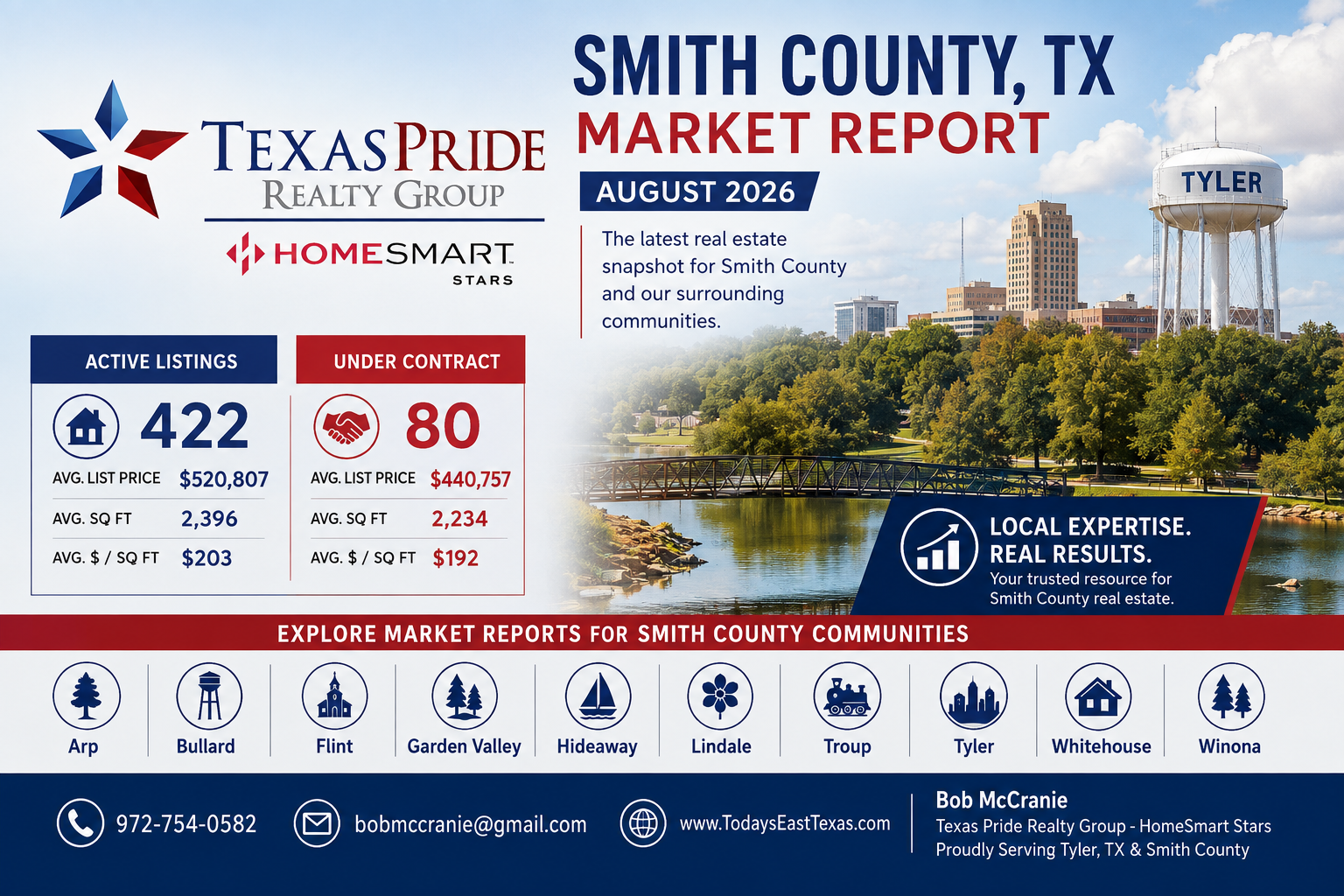
Smith County, TX Real Estate Market Report: August 2026


East Texas Housing Market Update | August 2026

Smith County, TX Real Estate Market Report: August 2026


Smith County enters late summer with substantial residential inventory and a meaningful pipeline of homes already under contract. The current market report shows 422 active residential properties and 80 properties under contract, giving buyers a broad selection while also showing that homes are continuing to move through the market.

Active Homes

422

residential properties currently active in Smith County.

Average List Price$520,807
Average Size2,396 sq. ft.
Average Price/Sq. Ft.$203

The typical active property in the report has about 3 bedrooms and 2 bathrooms.

Under Contract

80

residential properties currently under contract in Smith County.

Average List Price$440,757
Average Size2,234 sq. ft.
Average Price/Sq. Ft.$193

The typical property under contract has about 3 bedrooms and 2 bathrooms.

What the August Numbers Suggest

The relationship between active inventory and homes under contract provides useful context. The 80 properties under contract equal roughly 19% of the current active-property count. This is not a formal absorption-rate calculation because the supplied report does not provide a closed-sales count for the period, but it does show a substantial amount of transaction activity alongside the 422 homes currently available.

Pricing also differs between the two groups. Active properties average approximately $520,807, compared with $440,757 for properties under contract. That is a difference of about $80,050, or roughly 15%. The active inventory also averages 2,396 square feet versus 2,234 square feet under contract, so the price difference should not be interpreted as a direct measure of price reductions or appreciation.

Smith County Buyers Have Choices Across Multiple Price Points

The Smith County inventory spans a wide range of property types and price levels. The first page of the supplied active-property report includes homes priced from the low seven figures into the multi-million-dollar range, while the overall active inventory averages $520,807. Buyers comparing Tyler, Bullard, Flint, Lindale, Whitehouse and surrounding communities should look beyond countywide averages and examine the report for the specific city and property type that matches their search.

View the live Smith County residential market report for the latest available inventory and market data.

Explore Smith County and Tyler-Area Market Reports

Real estate conditions can change considerably from one East Texas community to another. Use the individual market reports below to compare current residential activity in communities throughout the Smith County area.

What Sellers Should Watch

With 422 residential properties currently competing for buyers, presentation, pricing and online visibility remain important. Sellers should compare their property with homes that are actually competing for the same buyers—not simply the countywide average. The 80 properties already under contract demonstrate that buyers are active, but the difference between active and under-contract pricing reinforces the importance of evaluating location, size, condition, amenities and competing inventory before choosing a list price.

What Buyers Should Watch

For buyers, the current inventory creates opportunities to compare neighborhoods, price ranges and property features before making a decision. At the same time, 80 homes are already under contract, so desirable properties can still attract buyers. Monitoring a live market report is more useful than relying on a one-time snapshot because listings can enter or leave the market throughout the month.

Buying or Selling in Tyler or Smith County?

Bob McCranie
Texas Pride Realty Group - HomeSmart Stars
Phone: 972-754-0582
Email: bobmccranie@gmail.com
Website: www.TodaysEastTexas.com

Contact Bob to discuss how current Smith County inventory and buyer activity may affect your East Texas real estate plans.

Data note: Market statistics in this article were taken from the supplied Smith County residential market-report snapshot. The source shows active and under-contract inventory; it does not provide a closed-sales section in the supplied file. Live report values may change as listings are updated.

Aug. 27, 2026

Should a Foreign National Purchase East Texas Real Estate Personally, Through an LLC, or Another Ownership Structure?

TodaysEastTexas

Your Complete East Texas Real Estate Guide

www.TodaysEastTexas.com

Should a Foreign National Purchase East Texas Real Estate Personally, Through an LLC, or Another Ownership Structure?

BM

Bob McCranie

Broker Associate, Texas Pride Realty Group - HomeSmart Stars

★★★★★ 45 Google Reviews | 24-Year Veteran Real Estate Agent | Over 1,150 Homes Sold | REALTOR® Since 2003

Quick Answer
It depends. Personal ownership is simpler for primary residences. LLCs add liability separation for rental property but also complexity and cost, and an LLC by itself does not remove U.S. estate tax exposure for non-resident owners. Consult a U.S. tax advisor and attorney—your specific situation determines the optimal structure.

Personal Property Ownership

Q: What are the advantages of personal property ownership?

Simplicity. Purchasing Tyler TX homes for sale personally involves straightforward title transfer. You own property directly; no corporate structure exists.

For primary residences or single properties, personal ownership often makes sense. Documentation is simpler, financing easier (some lenders prefer personal ownership), and administrative requirements minimal.

Tradeoffs: liability exposure. If someone injures themselves on your property, they may sue you personally. Your personal assets become exposed in significant injury scenarios. For a non-resident foreign owner, direct personal ownership also carries U.S. estate tax exposure (see below).

Limited Liability Company (LLC) Ownership

Q: Why would foreign nationals structure ownership through an LLC?

Liability separation. An LLC creates a business entity owning property separately from your personal assets. If someone sues regarding the property, their claims are generally directed at the LLC rather than your personal assets. An LLC does not replace adequate liability insurance, and it does not protect you from claims arising from your own negligence.

For Longview rental properties generating tenant disputes, injury claims, or maintenance incidents, LLC separation becomes valuable. Most professional investors structure rental property through LLCs.

Tradeoffs: complexity and cost. Texas charges a $300 filing fee to form an LLC, plus attorney and registered-agent costs. Annual state reporting and tax filings add administrative burden. Some lenders prefer personal ownership and charge higher rates for LLC borrowing.

"I recommend LLCs for rental properties," Bob advises. "Personal ownership for primary residences typically makes sense. Multi-property investors benefit significantly from LLC structure."

Tax Considerations for Foreign Owners

Q: Do personal and LLC ownership differ tax-wise for foreign nationals?

Somewhat. Personal ownership of rental property requires reporting rental income on your U.S. tax return (or accepting 30% withholding on gross rent if you don't elect net-basis taxation). A single-owner LLC is generally disregarded for income tax purposes, so its income flows through to your personal return the same way. However, a foreign-owned single-member LLC generally has its own annual IRS filing obligation (Form 5472 with a pro forma Form 1120) even when no tax is due, and penalties for missing it are steep.

Nacogdoches rental properties owned personally or through a single-owner LLC are generally taxed the same way on rental income. An LLC does not create extra deductions, but it can simplify accounting for multiple properties.

Foreign nationals face FIRPTA withholding when selling (covered in our FIRPTA article). Ownership structure can change how FIRPTA applies at sale, so consult a tax professional before choosing a structure.

Estate Tax: The Issue Many Foreign Buyers Miss

Q: Does the ownership structure affect U.S. estate tax?

Yes, and this is often the most important factor. Non-resident foreign owners are subject to U.S. estate tax on U.S. assets, including Texas real estate, with a statutory exemption of only $60,000 (compared with the multi-million-dollar exemption for U.S. citizens and residents). Some tax treaties provide relief.

Owning through a U.S. LLC by itself generally does not remove this exposure. Some buyers use other structures, such as a foreign holding company, to change the result, but those bring their own income tax tradeoffs and must be set up correctly before you buy. This is a question for a cross-border tax and estate-planning attorney, not something to decide at the closing table.

Financing Implications

Q: Do lenders treat personal and LLC ownership differently?

Significantly. Most lenders prefer personal mortgages—they're simpler and typically carry lower rates. LLC borrowing often faces higher rates and stricter qualification requirements; ask lenders for current quotes, since premiums vary.

Bullard homes under $400k financed personally often access better rates than LLC-owned comparable properties.

For foreign nationals, financing is already challenging. Personal mortgages face fewer obstacles than LLC mortgages. If you're financing, personal ownership may be practical necessity rather than choice.

Multi-Property Ownership Strategy

Q: Should investors use separate LLCs for each property?

Some do. Separate LLCs provide complete liability isolation: problem with one property doesn't expose other properties legally. However, this increases administrative complexity dramatically.

Alternative: single LLC owning multiple properties. Simpler administration while maintaining liability separation across portfolio. Investors building a portfolio of Marshall homes for sale often hold several properties in a single LLC.

Bob McCranie advises, "Start with one LLC for all rental properties unless you're building a massive portfolio with truly diverse risk profiles."

Land Trusts and Other Structures

Q: What about trusts or other ownership structures?

Land trusts exist in some states but aren't widely used in Texas. Revocable trusts are used mainly for estate planning and generally do not remove U.S. estate tax exposure for non-resident owners. Because of estate tax, many foreign buyers need more than a simple LLC or personal ownership, so get cross-border legal advice.

Consult a Texas real estate attorney regarding your specific situation. Ownership structure impacts liability, taxes, financing, estate planning, and future sale complications.

Professional Guidance Is Critical

This decision warrants consultation with U.S. tax professionals, estate-planning attorneys, and real estate attorneys familiar with foreign investor transactions. Your home country tax situation, U.S. tax exposure, liability concerns, and investment timeline all affect optimal structure.


Contact Bob McCranie at Texas Pride Realty Group - HomeSmart Stars | 972-754-0582 | www.TodaysEastTexas.com for a FREE 2026 Market Strategy Session